
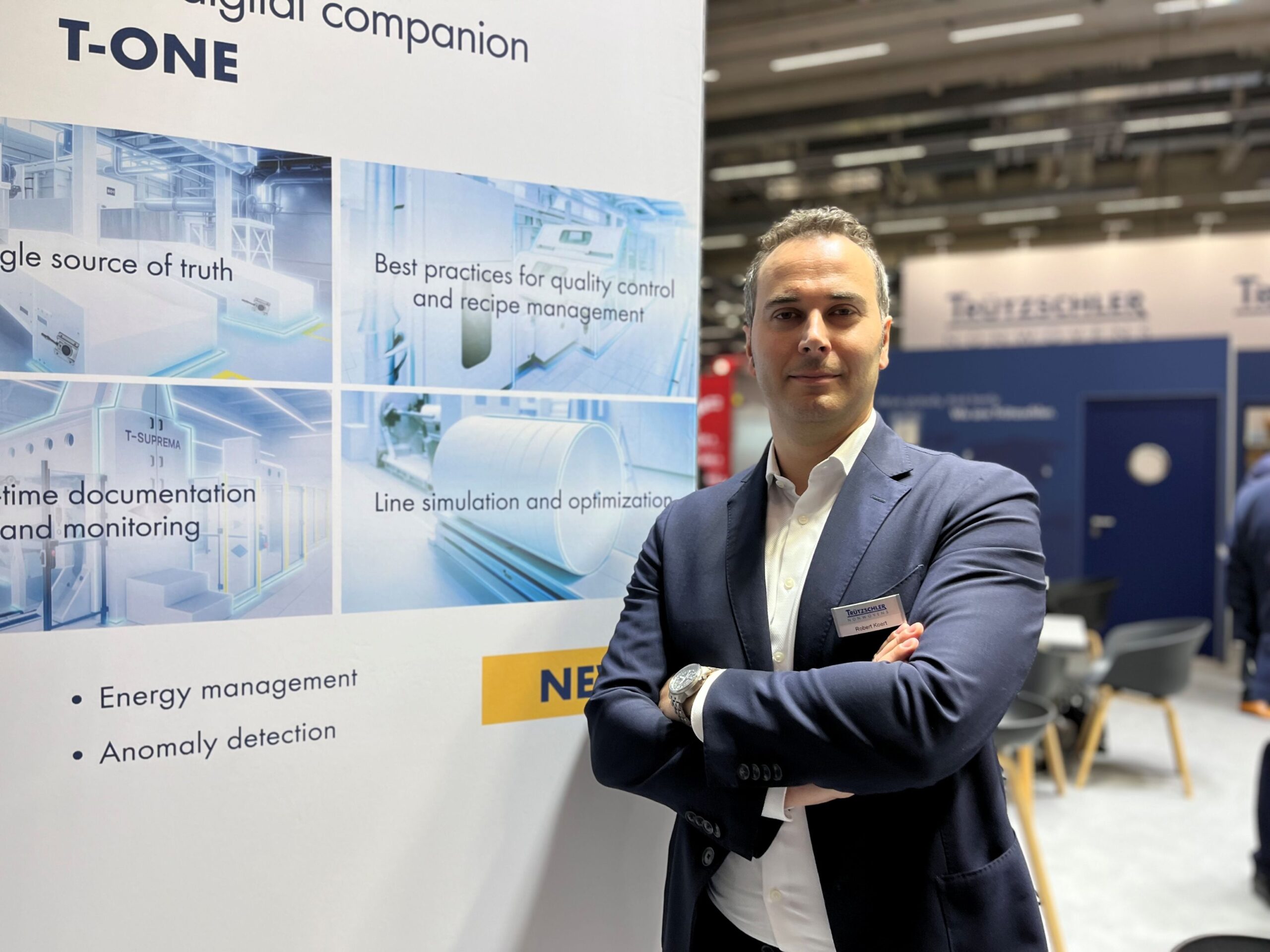
At Techtextil 2026, Robert Koert, Director Service, Trützschler Nonwovens, explains how customer proximity, OEM know-how, digital intelligence and lifecycle support are reshaping the way producers think about efficiency, flexibility and future-ready nonwoven production.
In nonwovens, the most important conversations are no longer about isolated machines alone. Producers are asking a larger question: how can a complete line remain stable, efficient, flexible and competitive across its full life cycle?
That question is becoming more urgent as the industry moves through faster product cycles, tighter quality requirements, changing fibre inputs, higher energy scrutiny and stronger pressure to modernise existing assets instead of simply replacing them. In this environment, the real value of a machinery partner is measured not only at installation, but in how well it helps producers perform over time.
For Trützschler Nonwovens, this is where service becomes strategic.
At Techtextil 2026 in Frankfurt, the company’s message was built around a broader idea of performance: intelligent lines, stronger process transparency, continuous modernisation and closer partnership with customers. Speaking at the fair, Robert Koert, Director Service, Trützschler Nonwovens, positioned the company’s service philosophy not as a support layer, but as a central pillar of competitiveness.
“Our approach is to go to the customers and focus on customer proximity,” says Koert. “We want to take care of their daily challenges, improve their machines and installations, and help make them more competitive in their own markets.”
That statement defines the larger Trützschler approach. The machine is not the end of the relationship. It is the beginning of a long-term performance journey.
From After-Sales Support to Line-Performance Partnership
In modern nonwovens manufacturing, service has moved far beyond maintenance schedules, spare parts and troubleshooting. It now directly influences output, quality consistency, energy efficiency, operator confidence and the producer’s ability to adapt to new market demands.
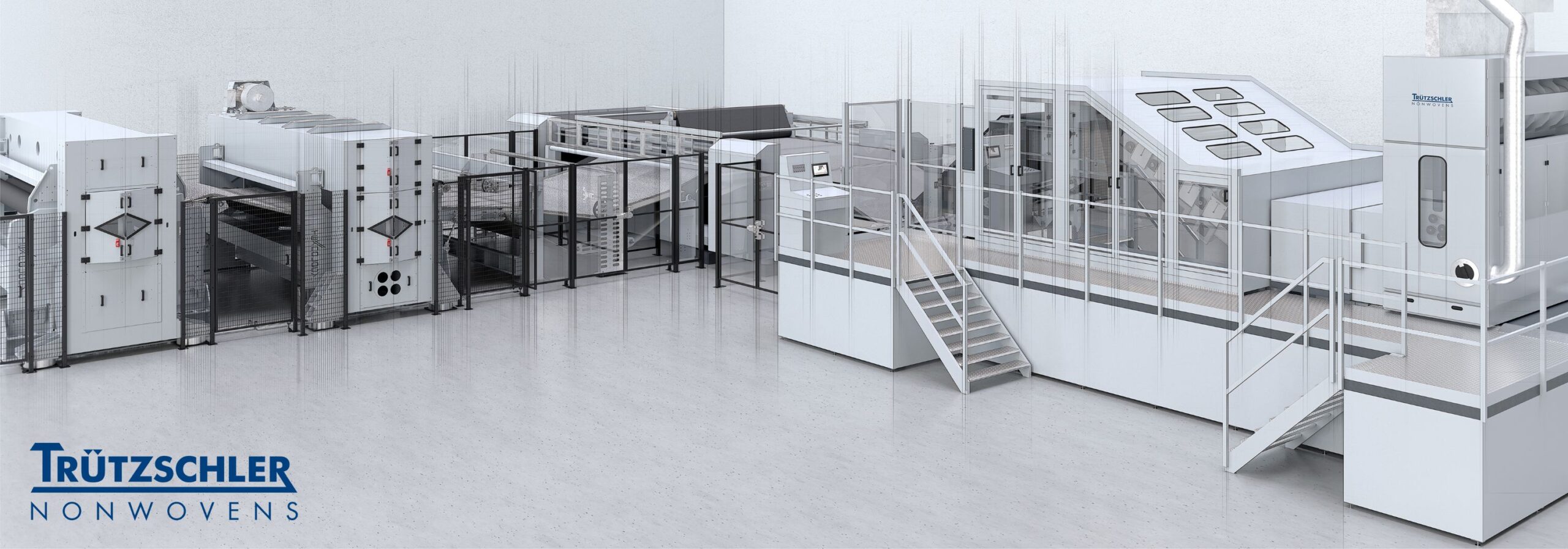
A nonwovens line is a complex production ecosystem. Fibre preparation, web forming, bonding, drying, winding, process control and operator discipline all interact with each other. A small deviation in one part of the line can influence the entire product. That makes service most valuable when it is rooted in a deep understanding of the complete process, not just the individual component.
This is where OEM knowledge becomes a powerful differentiator. Trützschler understands not only how a component works, but why it was engineered in a particular way, how it behaves under different process conditions and how it contributes to the line as a whole.
OEM Knowledge as a Customer Advantage
Koert is clear that proximity to the customer is essential because every installation teaches the company something valuable. Real production environments reveal what laboratory data alone cannot: changing fibre behaviour, operator habits, market-driven product shifts, bottlenecks, maintenance realities and the limits of existing line configurations.
“When we are in close connection with the customer, we learn a lot,” he says. “We learn about the machines, and we can bring in our process technology know-how and basic machine know-how to improve the systems. That is what customers are looking for: sustainable and stable operation.”
For producers, that translates into practical value. Better process understanding can help improve uptime, reduce variation, extend equipment life, enable product development and protect return on investment. In a sector where margins depend on both productivity and consistency, those gains are decisive.
Trützschler’s service proposition therefore carries a deeper implication: customers do not only receive technical assistance; they gain access to the engineering logic behind the line. That is difficult to replicate, and it becomes especially important as producers move into more demanding applications.
T-ONE: Turning Data into Operating Discipline
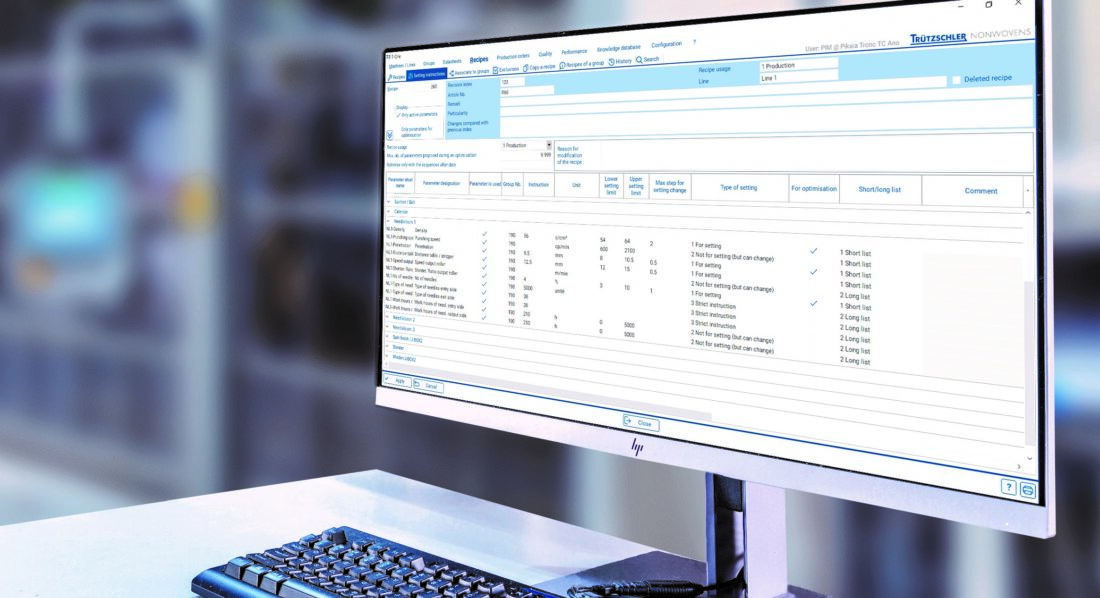
A major part of Trützschler’s future-facing proposition is T-ONE, its digital working environment for nonwovens production. At Techtextil 2026, the system’s enhanced capabilities were particularly relevant because they address two of the industry’s most pressing priorities: transparency and stability.
The latest T-ONE developments include energy management and camera-based anomaly detection. The energy management function enables real-time monitoring of electricity and gas consumption as well as CO2 footprint calculation per time unit, roll or order. The anomaly detection function uses cameras to identify fibre migration and accumulations at an early stage, helping producers prevent unplanned downtime and improve process transparency.
For Koert, the value of T-ONE is not limited to recording data. It lies in helping operators and plant teams act on that information consistently.
“T-ONE is an AI-based system,” he explains. “With anomaly detection, it helps to preventively optimise the plant and make sure the machine is operating at its best. We are not only maintaining overall equipment efficiency; we are making sure stability is there, that operators know how to operate the plant, learn with the system and share information.”
This point is important. In many production environments, performance differs between shifts because knowledge is unevenly distributed. An experienced day-shift team may run the line differently from a night-shift team. Documentation may sit in separate systems. Adjustments may depend too heavily on individual experience. T-ONE addresses this by creating a common digital environment for recipes, quality data, KPIs, production documentation, energy monitoring and process learning.
In practical terms, digitalisation becomes operational discipline. It gives producers a more reliable way to standardise knowledge, recognise deviations early and support continuous improvement across the full production team.
AquaJet at 30: A Mature Platform That Continues to Evolve
One of the most significant milestones in Trützschler Nonwovens’ current story is the 30-year journey of AquaJet, the company’s hydroentangling platform. For many technology companies, such a milestone could be treated as a legacy celebration. Koert frames it differently. For him, AquaJet remains relevant because it has never stood still.
“AquaJet is 30 years old, and that is a great milestone,” he says. “But we have never stopped innovating with AquaJet: changing concepts and adapting to customer needs.”
This distinction matters. Nonwovens is a constantly changing market. Producers face new fibre blends, new product qualities, new sustainability requirements and new end-use expectations. A technology platform remains valuable only if it can evolve with those changes.
Koert also links AquaJet to after-sales support. When customers need to change product qualities, adapt to new market requirements or solve production issues, Trützschler’s service and process teams can work with them to optimise the line.
“Nonwovens are always changing,” he says. “The industry is changing, and there are always aspects that need to be adapted. We are there for the customers, and AquaJet helps us be close to them and solve issues.”
That is the real story behind the milestone. AquaJet has stayed relevant not because it belongs to Trützschler’s past, but because it continues to support customers in the present — and can be adapted for the next generation of product requirements.
T-SUPREMA: Flexibility Proven in Real Production
Another important element of Trützschler’s Techtextil 2026 message is T-SUPREMA, the company’s needle-punching line platform developed with its cooperation partner Texnology s.r.l. The line has moved beyond concept into real market validation, with successful customer installations providing live proof of its performance.
This matters because technical nonwovens producers increasingly need flexibility. They may be serving geotextiles, filtration, automotive, acoustics, insulation, interiors, technical felts or composite applications. Demand can shift across basis weights, fibre types and product constructions. A line that can only serve one narrow product window becomes commercially limiting.
With T-SUPREMA, Koert highlights the ability to change settings quickly and run different product ranges with confidence.
“Together with our reliable cooperation partner Texnology, we have built reference plants that show the flexibility of T-SUPREMA lines,” he says. “Within a short time of changing machine settings, customers can produce several GSM products and several industrial applications. This helps them meet customer demand and show flexibility in their own markets.”
Trützschler’s official Techtextil communication underlines the same point: T-SUPREMA has been operating successfully at two customer sites since early 2026 and covers a broad basis-weight range from below 50 gsm to above 2,000 gsm. This is a critical advantage for producers who want to serve varied technical applications without compromising process stability or product consistency.
The significance of T-SUPREMA is therefore not only technological. It is strategic. It gives producers a platform to adapt faster, respond to different customer segments and reduce the risk of being locked into a narrow market position.
ATB Technology: Meeting the Hygiene Market’s Demand for Softness and Performance
In hygiene, Trützschler is also highlighting its Air-Through Bonding technology, widely referred to as ATB. This is particularly relevant for premium absorbent hygiene products, where softness, loft, skin compatibility and consistency are essential.
According to Trützschler, its ATB technology can reliably process ultra-fine fibres down to 0.4 dtex, enabling exceptionally soft nonwovens for demanding baby diaper applications. Typical uses include topsheets, backsheets and acquisition/distribution layers, where the material must combine comfort with function.
Koert emphasises that Trützschler’s ATB expertise has been built through years of work with global partners and can support both new lines and existing installations.
“ATB is an area where we have gained a lot of experience in recent years with our global partners,” he says. “With this knowledge of very fine fibres, we can bring expertise into other regions and customers. It is not only about installing new lines. It is also possible to overhaul or upgrade existing lines to meet today’s demands.”
That is an important commercial point. Many producers need to improve product performance without immediately investing in entirely new assets. Upgrades and overhauls can help them extend line life, raise product quality and respond to changing consumer expectations.
For the hygiene industry, where the end user’s perception of softness and comfort can define brand preference, such incremental performance gains are highly valuable. Trützschler’s ATB story therefore fits neatly into the company’s larger service philosophy: help customers make existing and new assets perform better for the market they serve.
TRUECYCLED: Recycling as an Industrial System
Recycling has become unavoidable in the textile and nonwovens industries. But the real challenge is not recognising the importance of circularity; it is making recycled fibre streams industrially viable, commercially relevant and technically reliable.
For Trützschler, TRUECYCLED addresses this challenge as a complete solution for textile waste recycling. The system covers the process from cutting and tearing textile waste to carding and drawing secondary fibres, supported by Trützschler’s process recommendations and machinery line-up. Koert describes recycling as both an ecological and industrial responsibility.
“Recycling is something everybody knows is important,” he says. “We have a lot of process know-how internally, and we need to be aware of global economic and ecological requirements. We need to close the cycle of fibres and waste, remove waste and take care of nature.”
This is where process knowledge becomes central. Textile recycling is not simply a matter of opening waste and putting it back into production. Fibre damage, shortening, contamination, blending behaviour and downstream quality all need to be managed carefully. A recycled product must still meet commercial expectations for quality and consistency.
TRUECYCLED reflects Trützschler’s broader strength: turning complex fibre challenges into controlled industrial processes. It also aligns with the wider market direction, where producers are under pressure to reduce waste, improve resource efficiency and demonstrate tangible progress on sustainability.
The Larger Message: Adaptability Will Define the Next Phase of Nonwovens
Taken together, Trützschler Nonwovens’ Techtextil 2026 story is not a list of separate technologies. It is a connected vision of how nonwovens production is changing.
T-ONE brings transparency, process discipline and digital intelligence. AquaJet demonstrates how a proven hydroentangling platform can remain relevant through continuous innovation. T-SUPREMA gives producers flexibility in durable needle-punched nonwovens. ATB technology supports the hygiene industry’s demand for softness and performance. TRUECYCLED addresses the urgent need to close fibre and waste cycles. Service and modernisation connect all of these capabilities across the full life cycle of the line.
What unites these themes is adaptability. Producers need lines that can adjust to new materials, new applications, new operating pressures and new sustainability requirements. They need partners who can help them improve today’s production while preparing for tomorrow’s market.
Koert’s emphasis on customer proximity gives this technology story its strongest human dimension. Even the most advanced line needs people who understand how it behaves, how it can be improved and how it can be adapted to future requirements. That is where Trützschler’s OEM knowledge and service presence become essential.
The company’s position is clear: nonwovens producers do not need machinery alone. They need performance over time. They need stability across shifts. They need digital support that makes decisions better. They need technologies that can evolve with the market. And they need a partner who stays close after the line is installed.
At Techtextil 2026, Trützschler Nonwovens presented exactly that proposition. Its message was not simply about machines, software or recycling systems. It was about helping producers remain competitive in a market where change is constant and performance is measured across the full life of the line.
That may be the most important insight from Robert Koert’s conversation: the future of nonwovens will not be won by equipment alone. It will be won by those who combine engineering excellence with digital intelligence, lifecycle service, process know-how and the discipline to keep customers competitive for the long run.