

By K. Gopalakrishnan
In an era where sustainability is no longer optional but imperative, the textile industry is undergoing a decisive transformation—from a linear consumption model to a circular economy. At the forefront of this shift is Cormatex, the Italian technology leader that has redefined how textile, agricultural and generally speaking industrial waste can be converted into high-value, commercially viable products. With its advanced nonwoven and airlay technologies, Cormatex is not just enabling recycling—it is unlocking entirely new possibilities for value creation.
From Waste to High-Performance Applications
Cormatex’s technology demonstrates that waste is no longer an end-of-life problem but a starting point for innovation. Whether it is fabric waste, garment waste, fibre waste, or yarn waste, the company’s systems can process a wide variety of inputs and transform them into functional nonwoven products.
One of the most significant applications lies in the production of insulation panels, which are widely used across industries for soundproofing and thermal insulation. These panels, derived entirely from recycled textile inputs, offer performance characteristics comparable to conventional materials while significantly reducing environmental impact.
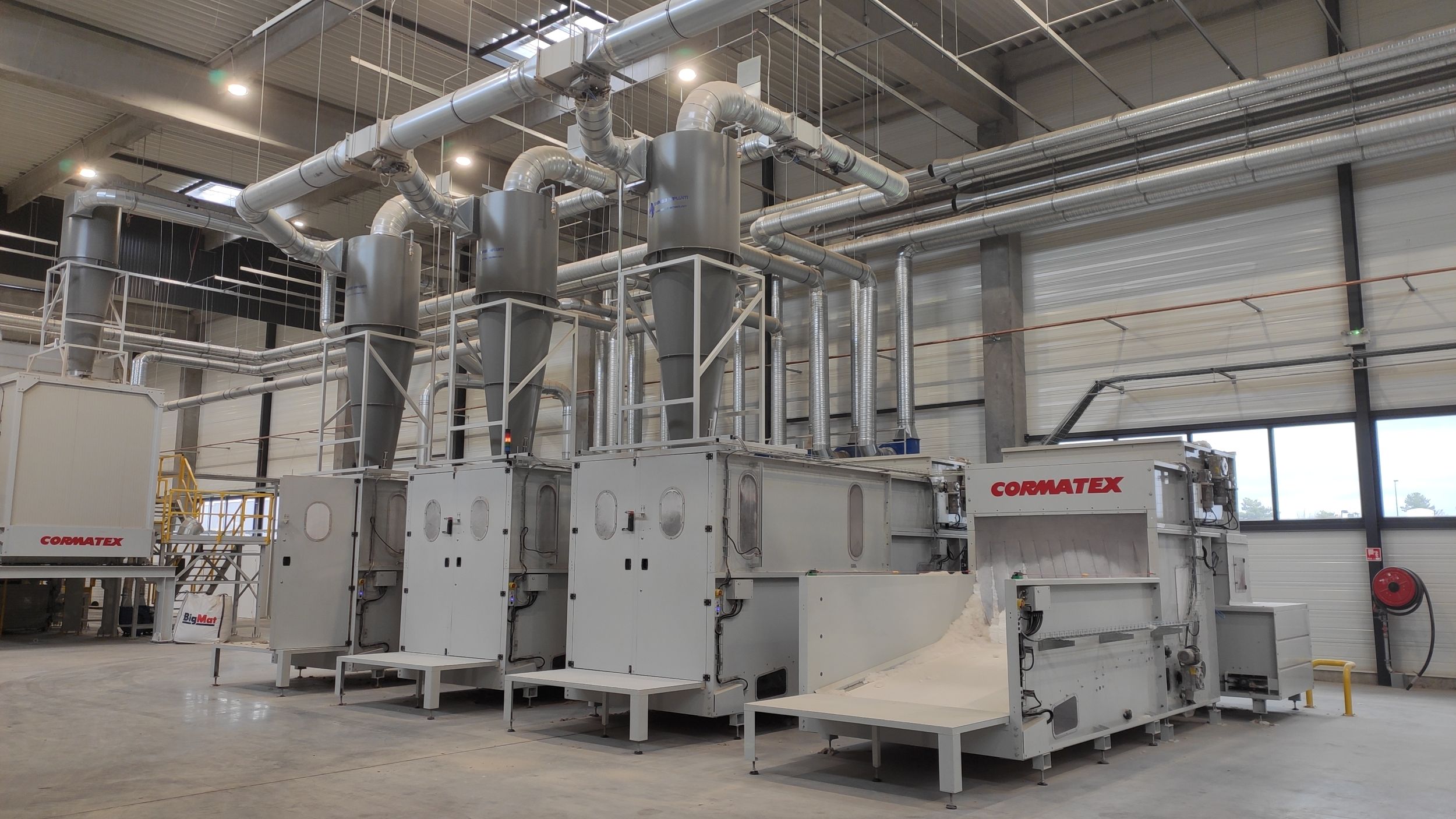
Beyond insulation, the same recycled material can be further engineered into flooring tiles, kitchen wortops, and 3D mouldable components. The flexibility of these materials allows them to be customised into various shapes and structures, opening opportunities in furniture, interior design, and construction applications. This versatility highlights the true potential of textile waste as a raw material for multiple downstream industries.
Expanding Horizons with Agri-Waste and Industrial Waste
Cormatex’s recycling capabilities extend far beyond textiles. The company has successfully demonstrated the conversion of agricultural residues such as sugarcane bagasse, hemp shives, rice straw and husks, paludiculture crops and seagrass into commercially viable nonwoven products.
Instead of being burned or sent to landfills, these materials can be transformed into packaging solutions, carpet underlays, insulation materials, paddings, and even high-strength structural panels such as partition walls. These applications not only reduce environmental damage but also create new revenue streams for industries dealing with agricultural byproducts.
Additionally, Cormatex has developed solutions for processing paper waste into nonwovens, further expanding the scope of recyclable inputs. All resulting products are designed to be fire-retardant, skin-friendly, and environmentally safe, reinforcing their suitability across a wide range of end-use sectors.
Tackling Complex Waste Streams
One of the most compelling aspects of Cormatex’s technology is its ability to process difficult and traditionally non-recyclable materials.
For instance, tyre cord waste, which typically ends up in landfills, can be converted into nonwoven materials suitable for carpet backing, wall cladding, and insulation applications. Similarly, post-consumer carpet waste can be recycled into underlays, ensuring that bulky and complex waste streams are reintegrated into the value chain.
Another breakthrough lies in leather recycling. Traditional leather processing is resource-intensive, particularly in terms of water consumption. Cormatex’s dry recycling approach allows for the conversion of any kinf of post-industrial leather waste—such as shoes or bags trimmings, buffing dust, finished remnants—into reusable materials without additional water usage, significantly reducing environmental burden.
Equally noteworthy is the recycling of carbon fibre waste, a high-value but challenging material. By converting it into nonwoven structures and further processing it into composite panels, Cormatex enables the production of materials with excellent thermal insulation and high impact resistance, catering to advanced industrial applications.
Driving Circular Economy with Commercial Viability
What sets Cormatex apart is not just its technological capability, but its focus on economic feasibility. The recycling solutions offered are not experimental—they are designed for industrial scalability with attractive return on investment, often delivering payback within one to two years.
This strong business case is critical in accelerating adoption, particularly in markets like India, where cost competitiveness and sustainability must go hand in hand. By enabling manufacturers to convert low-value or waste materials into high-margin products, Cormatex creates a compelling proposition that aligns environmental responsibility with profitability.
A Strategic Opportunity for the Textile Industry
As global pressure mounts to reduce waste and carbon footprints, the ability to recycle and upcycle diverse materials will define the next phase of growth in the textile and technical textile sectors. Cormatex’s technologies offer a clear pathway to achieve this—bridging the gap between sustainability and industrial performance.
For India and other emerging markets, where both textile waste and agricultural residues are abundantly available, the potential is particularly significant. By adopting such advanced recycling solutions, the industry can not only address environmental challenges but also position itself as a global leader in sustainable manufacturing.
Cormatex is demonstrating that the future of textiles lies not just in producing more, but in producing smarter—by reusing, recycling, and reimagining waste. Its technologies are transforming discarded materials into high-performance products across industries, unlocking new possibilities for innovation, sustainability, and profitability.
In doing so, Cormatex is not merely supporting the circular economy—it is actively engineering it.


