

How efficient oven technology can improve the economics of nonwovens production
Energy efficiency is becoming an increasingly important factor in nonwovens manufacturing. Rising energy costs are putting pressure on production economics, particularly in processes involving thermal treatment, drying or bonding. For operators of existing production lines, upgrading the oven can therefore offer significant potential to reduce energy consumption and operating costs.
A practical example can be found at PT. Hilon Indonesia, where an existing oven was replaced while the production line itself remained in operation.
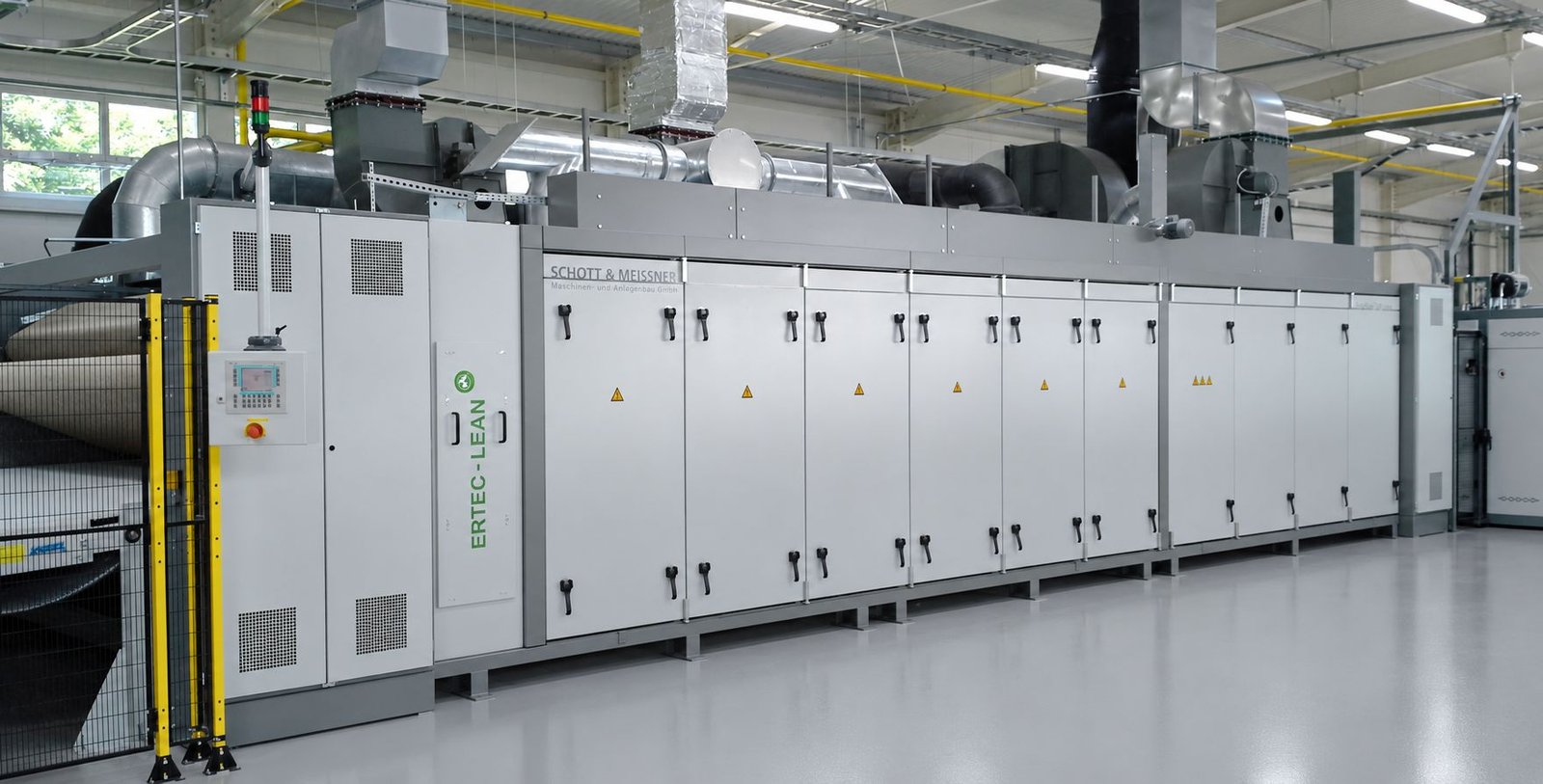
According to PT. Hilon Indonesia, the Schott & Meissner oven now requires only around one third of the energy consumed by the previously installed oven. This represents an energy reduction of approximately 67%.
Efficient Thermal Treatment
Energy efficiency in a thermal process depends on more than the nominal process temperature. Efficient heat transfer, uniform temperature distribution, efficient process-air circulation and controlled exhaust air are important factors in ensuring that thermal energy is used effectively.
The design of the Schott & Meissner oven is specifically focused on minimizing energy losses. The oven features complete thermal insulation with almost no thermal bridges, helping to keep heat inside the process chamber. An efficiently designed air circulation system ensures effective and uniform heat transfer across the material width, while controlled exhaust air minimizes the loss of valuable thermal energy.
Another key element is the use of state-of-the-art, energy-efficient heating systems. Together with the optimized air circulation and insulation concept, these systems ensure that the supplied energy is used as efficiently as possible.
Schott & Meissner develops customized oven systems for a wide range of applications in the nonwovens industry. The systems are designed to meet the specific requirements of each production process while combining precise thermal conditions with efficient energy utilization.
The Economic Impact of Oven Technology
The experience of PT. Hilon Indonesia highlights an important consideration for nonwoven manufacturers operating established production lines: significant efficiency improvements do not necessarily require the replacement of the entire production line.
Replacing an inefficient oven can be a targeted approach to improving the energy performance of an existing production system. A reduction in energy consumption directly lowers the energy cost associated with each kilogram of material processed.
Schott & Meissner also offers heat recovery systems , which can further reduce energy consumption by recovering thermal energy from the exhaust air and making it available for reuse within the process.
Oven efficiency is therefore not only a sustainability consideration, but also an important factor in production economics and operating costs.
For manufacturers evaluating the performance of an existing nonwovens line, the oven should therefore be considered an important part of the overall production economics.
How efficiently is the existing oven operating – and what potential could be unlocked by upgrading to a more energy-efficient solution?
A targeted oven replacement can provide an opportunity to reduce energy consumption and operating costs while improving the long-term competitiveness of an existing nonwovens production line.


