
With its state-of-the-art manufacturing facility in Ranipet now fully operational, AMANN Group is moving into a new phase of growth in India—combining global thread expertise with local manufacturing, faster delivery, application support and a growing portfolio of sustainable and high-performance solutions.
For AMANN Group, India is no longer simply another market in its global network. It is emerging as a strategically important manufacturing and consumption centre, with opportunities extending across apparel, home textiles, footwear, leather and technical applications. The German thread specialist, which began its Indian journey with a trading operation in Chennai in 2007, has now taken a significant step forward by establishing a modern manufacturing facility at Ranipet in Tamil Nadu.
The transformation reflects AMANN’s confidence in the long-term potential of the Indian textile and allied industries. After spending years understanding the market, its customers and their requirements, the company commenced construction of the Ranipet plant in 2022. Commercial production began towards the end of 2024, following a two-year delay caused by the pandemic. The facility has since completed its ramp-up phase and is now fully equipped to serve the Indian market with AMANN’s portfolio of products.
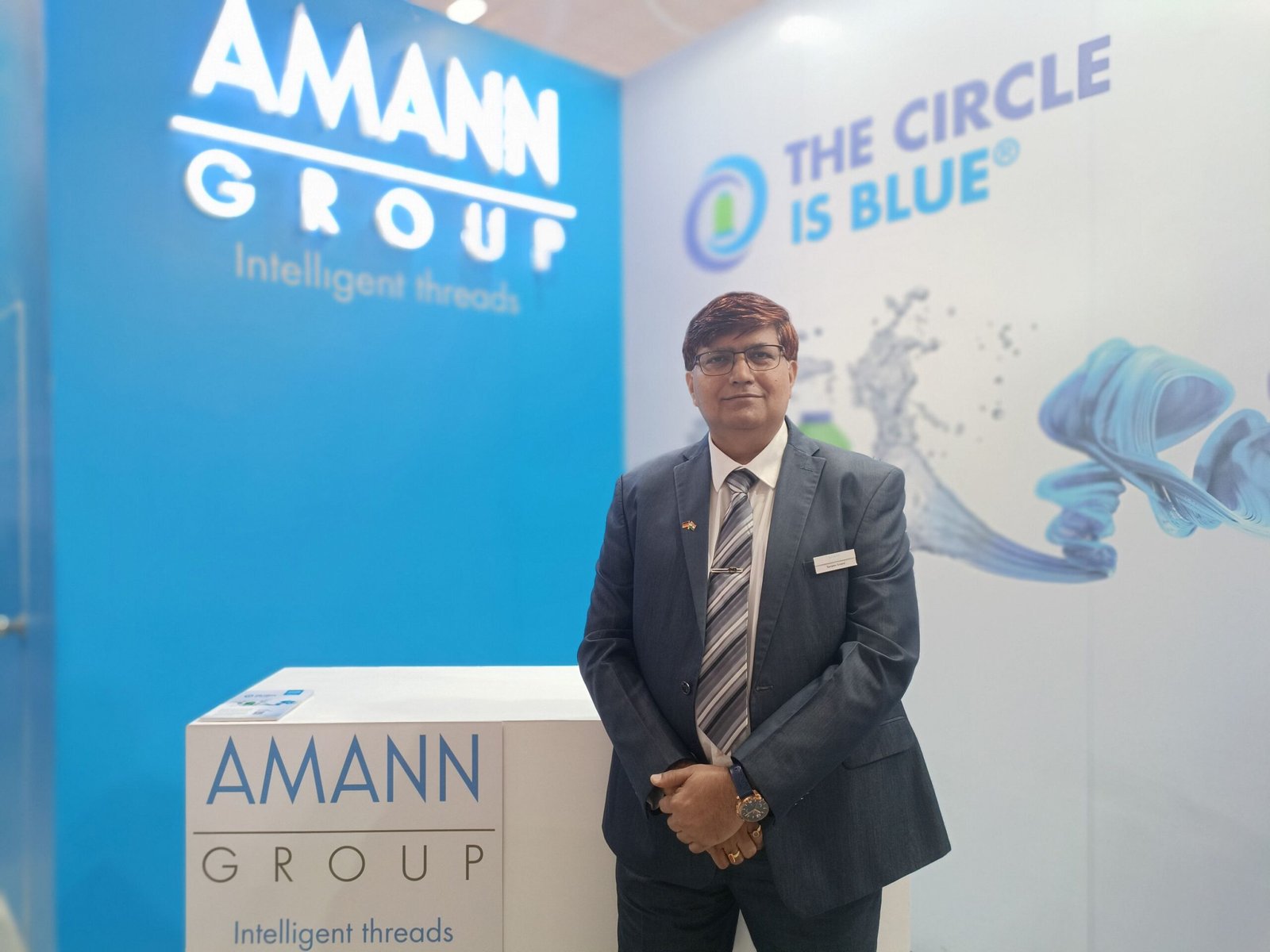
For Sanjeev Grewal, Regional Business Director – Asia, Middle East & Pacific, the manufacturing investment represents much more than localisation. It is a clear expression of AMANN’s long-term commitment to India.
From Trading to Manufacturing
AMANN’s Indian journey began with a trading company in Chennai. That initial presence enabled the company to develop a deeper understanding of the market before committing to manufacturing. Today, the Ranipet facility is changing the nature of that engagement.

The basic philosophy is “India for India”, with the plant serving the domestic market while also supplying Sri Lanka and the Middle East. Its product portfolio currently covers the fashion and accessories segment as well as leather and footwear, with opportunities across home textiles and other applications.
The move to local manufacturing provides several advantages. Customers receive internationally standardised AMANN products manufactured locally, supported by improved service and faster delivery. Local production also makes the products more economically competitive by reducing the impact of customs duties and other import-related costs.
The result is a stronger customer proposition: global quality, local availability, application expertise and faster response.

The response from customers and global brands has been encouraging. For AMANN, the new facility has reinforced the message that India is a long-term strategic market rather than simply a sourcing location.
India: A Market, Not Just a Manufacturing Base
The scale of India’s domestic market is one of the principal reasons behind AMANN’s growing commitment.
Grewal points to the country’s demographic and economic dynamics as important long-term drivers. India’s population is stable or growing, while rising GDP and increasing purchasing power are supporting greater consumption of apparel, footwear and other lifestyle products. At the same time, the country’s retail landscape is evolving rapidly, with organised retail and large domestic brands gaining scale.
This combination makes India unusual from AMANN’s perspective. The country offers both a growing manufacturing ecosystem and a substantial domestic consumption opportunity.
The potential is particularly visible in leather and footwear. According to Grewal, only a relatively small share of India’s leather footwear production is exported, with the overwhelming majority serving the domestic market. This demonstrates the depth of the opportunity for specialised thread solutions within India itself.
India’s development in technical textiles, automotive and other industrial sectors further broadens the addressable market. For AMANN, therefore, the Indian strategy extends well beyond conventional apparel.
Innovation Across Applications
While manufacturing localisation is strengthening AMANN’s market presence, innovation remains central to the company’s proposition.
The company has developed a broad portfolio of sewing and embroidery threads designed to address increasingly specialised requirements in fashion, footwear, leather, automotive and technical textiles. Its latest innovations demonstrate how thread technology is evolving from a basic sewing component into an important enabler of product performance, aesthetics and circularity.
Among the recent developments is AeoniQ-Fil, a biodegradable sewing thread made from renewable cellulosic fibres. Designed for more environmentally responsible production without compromising performance, the product has also received recognition for ecological quality.
Another significant development is Smart Stitch, a heat-dissolvable sewing thread designed to facilitate garment disassembly. When exposed to controlled heat, the thread melts, allowing components such as zips, buttons, polyester elements and interlinings to be separated more easily. This can simplify subsequent reuse or recycling and supports the development of more circular textile products.
AMANN is also developing Waterfil, a water-soluble thread for temporary seams, along with reflective sewing and embroidery threads designed to retain their functionality over longer periods. Saba Evo, based on compact core-spun technology, delivers a low-hairiness thread for premium garments where a clean appearance is important. Isacord UV, meanwhile, is designed to maintain embroidery colour performance under prolonged exposure to sunlight.
These innovations reflect AMANN’s broader strategy of developing application-specific solutions rather than competing purely on conventional sewing-thread specifications.
Automation at the Heart of Manufacturing
The Ranipet facility itself demonstrates AMANN’s technology-driven approach.
The plant incorporates highly automated production systems, including robotic technologies, and even its dyeing operation is fully automated. This allows the company to maintain consistent product quality while reducing dependence on manual intervention.
For AMANN, automation is closely linked to quality and sustainability. Consistent process control is critical for thread manufacturing, where uniformity and reliability directly affect sewing performance on high-speed production lines.
The investment also positions AMANN to transfer advanced manufacturing know-how into the Indian textile ecosystem—an important aspect of its philosophy of developing markets through technology and knowledge sharing.
Sustainability Beyond the Product
Sustainability is perhaps the strongest common thread running through AMANN’s technology, manufacturing and innovation strategy.
The company has pursued sustainability for more than a century, with its German operations historically incorporating renewable energy generation. That philosophy has now evolved into a comprehensive approach covering water, energy, waste, products and social responsibility.
The Ranipet operation reflects this approach. According to Grewal, the facility recycles approximately 91% of its water, while the remaining water is evaporated. Residual material is recovered in powder form and can be utilised in applications such as cement and brick manufacturing. The plant’s electricity is sourced entirely from renewable sources such as solar and wind.
Importantly, AMANN views sustainability as extending beyond environmental metrics. Its approach also encompasses social responsibility, gender equality, education and community development. The company’s foundation has supported initiatives in areas including education and development, while its operations in countries such as India and Bangladesh are also intended to facilitate technology and know-how transfer.
Building the Next Phase in India
With the Ranipet plant now fully ramped up, AMANN’s next phase in India will focus on strengthening its market presence, expanding customer engagement and increasing the adoption of its specialised and sustainable thread technologies.
The company’s objective is not simply to manufacture locally, but to build a stronger ecosystem around its customers through technical expertise, application support, reliable supply and faster response. The ability to serve multiple segments—from fashion and home textiles to leather, footwear and eventually wider industrial applications—provides considerable room for expansion.
India’s growing domestic consumption, expanding manufacturing base, increasing technical sophistication and rising emphasis on sustainability create a favourable environment for AMANN’s proposition.
After more than a century of global experience and nearly two decades of direct engagement with India, AMANN is now entering the market with a substantially stronger foundation. Its transition from a trading operation to a fully established manufacturing base marks a significant strategic milestone.
The direction is clear: AMANN intends to be closer to the Indian customer, manufacture closer to the market and bring global innovation into local production. With sustainable materials, smart thread technologies, automated manufacturing and application-specific solutions becoming increasingly important to the future of textiles, the Ranipet investment gives the company a platform from which to build its next chapter of growth in India.