

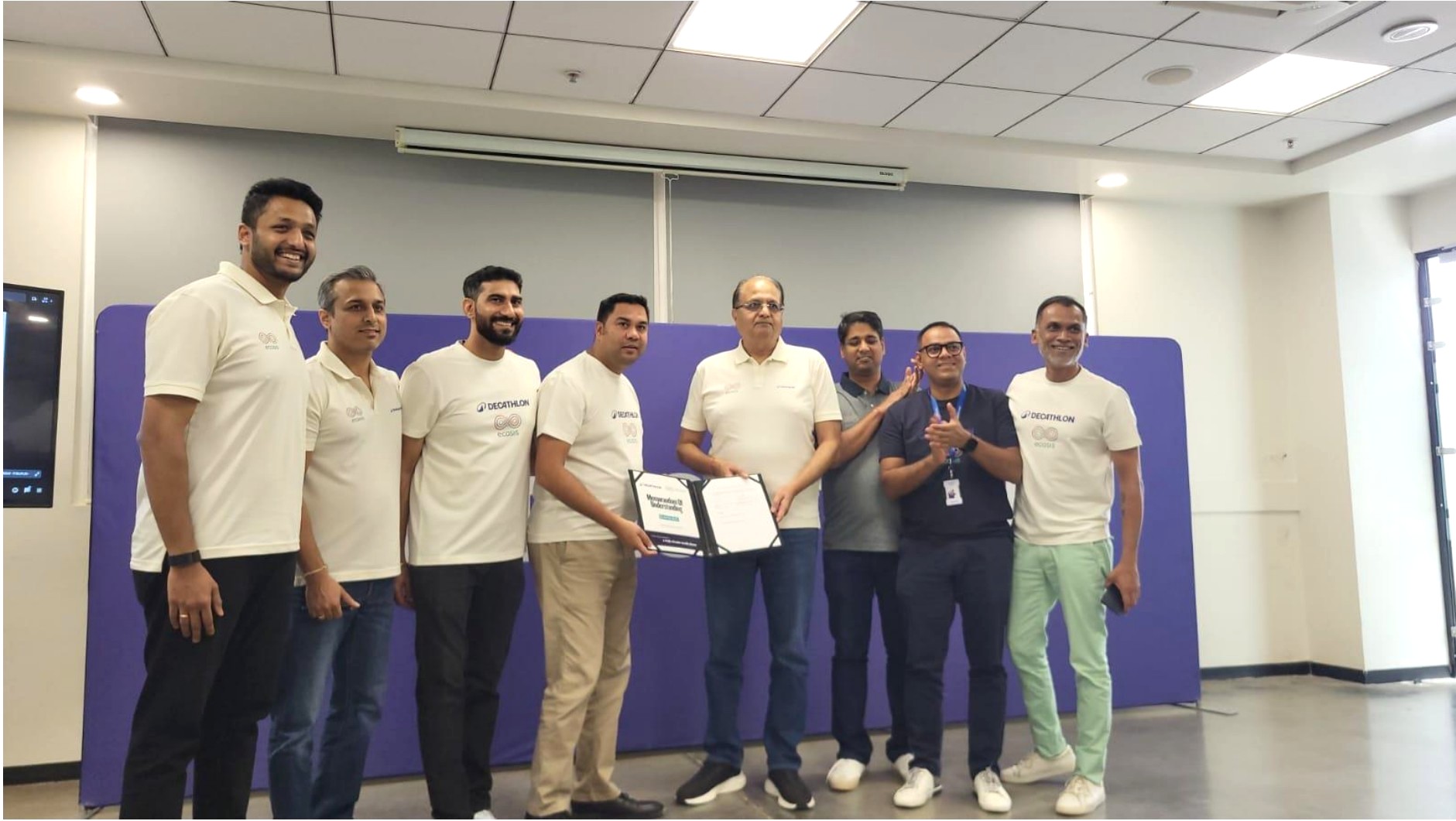
In a landmark development for India’s textile circularity mission, Texfil Private Limited — a wholly owned subsidiary of Filatex India Limited and home to the Ecosis™ chemical recycling technology — has signed a Memorandum of Understanding (MoU) with Indeca Sporting Goods Pvt. Ltd., an entity of the Decathlon Group, France. The partnership aims to accelerate the adoption of high-quality, textile-to-textile recycled polyester in sports apparel manufactured for Decathlon India.

This collaboration marks a major step forward in India’s transition from traditional bottle-to-fiber recycling toward true circular textile systems, ensuring that polyester apparel at the end of life is brought back into the material loop instead of becoming waste.
A Partnership Built on Innovation and Circularity
Texfil has developed a patented, in-house chemical recycling process based on glycolysis that preserves the molecular integrity of polyester — enabling the production of virgin-grade recycled chips under the brand Ecosis™. Unlike conventional recycling that converts PET bottles into textiles only once, Ecosis™ is designed as a “perpetual motion machine” capable of regenerating polyester textiles repeatedly.
The company currently operates an 800 kg/day pilot plant and is in the process of establishing a state-of-the-art commercial facility with a capacity of 26,750 MTPA, scheduled for commissioning in September 2026.
Under the MoU, Decathlon Sports India will conduct structured trials of Ecosis™ chips and yarn across its manufacturing network. The partnership also envisions a reverse supply chain where pre- and post-consumer polyester textile waste from Decathlon’s sourcing ecosystem can be channelled back to Texfil for high-quality chemical recycling.
Both organisations have committed to scaling the use of Ecosis™ recycled polyester within Decathlon’s products — aligning strongly with India’s national objectives on decarbonisation, resource circularity, and sustainable manufacturing.
A Shared Vision for a Low-Carbon, Circular Future
This association is strategically aligned with multiple Government of India frameworks, including:
- MNRE’s National Bioenergy and Biomass Programmes,
- The Ministry of Agriculture & Farmers Welfare’s Crop Residue Management policies, and
- The Ministry of Power’s decarbonisation goals,
All of which collectively promote responsible use of biomass, circular material flows, and reduction of fossil-fuel dependency.
For Decathlon — one of the world’s largest sports retailers and manufacturers with 101,000 teammates and over 1,750 stores worldwide — the collaboration amplifies its commitment to responsible sourcing, innovation, and environmental stewardship.
Leadership Perspectives: Driving Circularity with Purpose
Mr. Madhu Sudhan Bhageria, CMD, Filatex India Limited, remarked:
“This collaboration reflects our shared commitment to circularity and sustainable material innovation. Ecosis™ is built on the belief that polyester textiles should not be treated as waste, and we are excited to work with Decathlon India to bring sustainable materials into mainstream sports apparel.”
Mr. Deepak D’Souza, Production Director, Southwest Asia, Decathlon, noted:
“This collaboration embraces our journey focused on responsible sourcing and innovation. We are happy to see this collaboration with Ecosis and the positive impact it can create for our people and the planet.”
Bringing a deeper strategic lens to the partnership,
Mr. Vedansh Bhageria, Director, Ecosis and Vice President, Filatex, shared:
“This MoU marks the culmination of a nearly two-year journey — one built on technical evaluations, shared principles, and a joint vision of true circularity at scale. What makes this significant is its emphasis on real manufacturing conditions, scalability, quality consistency, and traceability — the very factors needed for circular materials to move into mainstream products.”
He added that the MoU offers a powerful pathway for deploying Ecosis’ patented textile-to-textile recycling technology with the support of Filatex India and in collaboration with a global leader like Decathlon.
Why This Collaboration Matters for the Industry
1. A Scalable Route to High-Quality Recycled Polyester
Ecosis™ enables true fibre-to-fibre recycling by regenerating polyester to virgin-grade quality, ensuring no compromise in performance — a critical requirement for sportswear.
2. Strengthening India’s Circular Textile Ecosystem
By incorporating structured trials and reverse waste collection systems, the model aims to demonstrate how large-scale circularity can be operationalised within real industry settings.
3. Reducing Reliance on Virgin Resources
With the upcoming 26,750 MTPA commercial facility, Texfil is poised to significantly reduce the industry’s dependency on fossil-fuel-based polyester.
4. Advancing Decarbonisation Goals
The collaboration contributes meaningfully to India’s broader climate ambitions by creating a low-carbon, traceable material stream for high-volume textile manufacturing.
The partnership between Ecosis™ and Decathlon India represents a transformative milestone in the evolution of textile circularity in India. Anchored in science-based innovation, industry-scale engineering, and a shared commitment to environmental responsibility, the collaboration is poised to redefine how recycled polyester is produced and adopted in mainstream apparel manufacturing.
As Ecosis™ prepares to scale its patented chemical recycling technology and Decathlon deepens its focus on sustainable sourcing, this MoU sets the stage for a new era of circular, coal-free, and low-carbon textile production — one that can serve as a blueprint for the global industry.
Together, Ecosis™ and Decathlon are not just recycling textile waste — they are reshaping the future of sustainable sportswear.