
By K. Gopalakrishnan
Global Hygiene Leader Focuses on Product Performance, Sustainability and Growth Opportunities in Emerging Markets
The global hygiene industry is undergoing a significant transformation, driven by rising consumer awareness, increasing demand for comfort and performance, sustainability expectations, and expanding accessibility to hygiene products across emerging economies. At the heart of this evolution are technology providers that enable manufacturers to create lighter, more efficient, and higher-performing products.
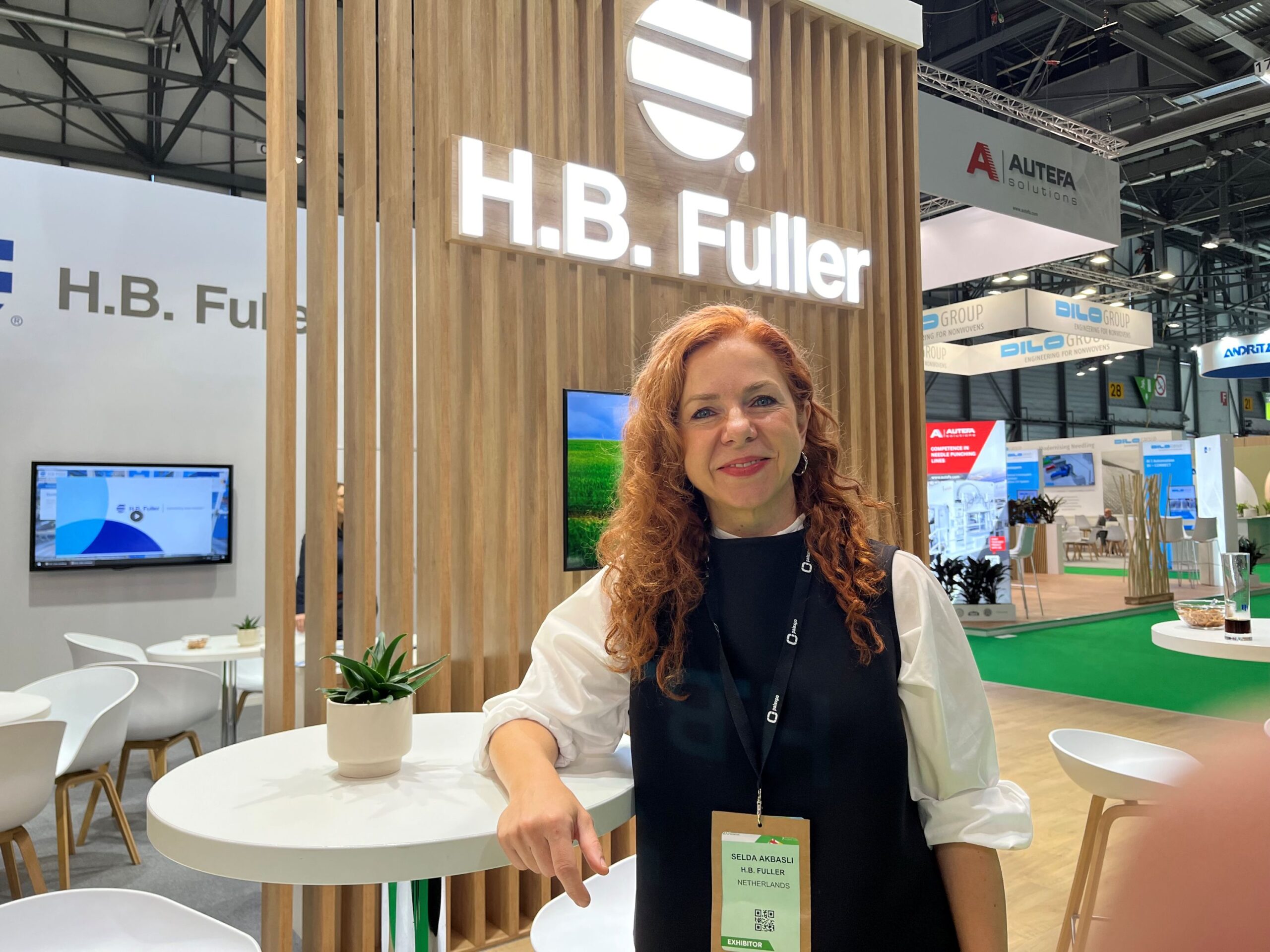
Among the industry’s leading innovators is H.B. Fuller, the world’s largest pure-play adhesives company, which has established a strong position in the hygiene and nonwovens sector through its advanced adhesive technologies, consumer-focused innovation strategy, global technical expertise, and robust supply assurance capabilities that help customers maintain reliable operations and business continuity across global markets. Speaking to The Textile Magazine during INDEX 2026, Selda Akbasli, Global Hygiene Business Leader, shared insights into the company’s growth strategy, technology leadership, sustainability initiatives, and the significant opportunities emerging in markets such as India.
Hygiene Business at the Core of H.B. Fuller’s Growth Strategy
For H.B. Fuller, hygiene is not merely another market segment but one of the company’s most strategic global businesses. The company’s adhesive solutions play a critical role in the manufacturing of baby diapers, feminine hygiene products, and adult incontinence products, serving millions of consumers worldwide.
As awareness regarding personal hygiene continues to increase globally, particularly in developing markets, demand for higher-quality products is growing rapidly. Consumers today are looking for products that offer superior comfort, enhanced softness, reliability, and sustainability while maintaining affordability.
According to Akbasli, these evolving expectations are creating significant opportunities for innovation throughout the hygiene value chain. Manufacturers are increasingly seeking technologies that can improve product performance while simultaneously reducing environmental impact. H.B. Fuller is responding to these needs through continuous innovation and close collaboration with customers across global markets.
Advancing Comfort Through Next-Generation Adhesive Technologies
One of the key themes highlighted by H.B. Fuller at INDEX was the role of advanced adhesive technologies in enabling the next generation of high-performance hygiene products. As manufacturers seek to improve comfort, reduce material usage, and support sustainability objectives, adhesive innovation is becoming an increasingly important enabler of product design and functionality.
Among the innovations showcased was Full-Care® 6550, a next-generation positioning adhesive developed for feminine hygiene products. Designed to provide secure fixation across a variety of fabric types, including cotton and microfiber, the technology enables manufacturers to achieve reliable product performance while reducing adhesive add-on levels by up to 20%. By delivering strong adhesion with less material, Full-Care® 6550 supports the development of lighter, more comfortable products without compromising protection or user confidence.
H.B. Fuller also highlighted Full-Care® 5887 Xtra, an innovative adhesive solution designed for emerging softer and more sustainable hygiene materials. As manufacturers increasingly incorporate moisture-absorbing and alternative substrate technologies, achieving reliable bonding can become more challenging. Full-Care® 5887 Xtra addresses this need by providing strong adhesion even under wet conditions, enabling the use of softer materials while reducing adhesive consumption by up to 20%.
Together, these innovations illustrate how advances in adhesive technology are helping the hygiene industry balance consumer expectations for comfort and performance with growing demands for sustainability and resource efficiency. By enabling lighter product constructions, reduced material consumption, and improved bonding performance, next-generation adhesives are playing a critical role in shaping the future of hygiene product design.
Innovation Driven by Customer Needs
A recurring theme throughout Akbasli’s discussion was the importance of listening to customers and understanding market requirements before developing new technologies.
Rather than pursuing innovation in isolation, H.B. Fuller places the voice of the customer at the center of its product development strategy. The company works closely with hygiene product manufacturers to understand their production challenges, efficiency goals, and evolving market requirements.
At the same time, the company recognizes that the needs of end consumers are changing rapidly. Increased awareness of personal hygiene, growing expectations regarding comfort and convenience, and changing lifestyles are influencing product development across baby care, feminine care, and adult incontinence categories.
As a result, innovation at H.B. Fuller focuses on delivering higher-performance adhesive solutions that improve manufacturing efficiency while enhancing consumer comfort. Lower application temperatures, stronger bonding performance, improved softness, and reduced material usage are among the areas where the company continues to invest.
Akbasli emphasized that innovation must be practical and meaningful. It must combine technical expertise, product leadership, and customer understanding to create solutions that genuinely improve people’s lives. From infants to adults, hygiene products touch consumers at every stage of life, making product performance and reliability critically important.
Technology Leadership Backed by Global R&D Capabilities
H.B. Fuller’s leadership position in hygiene adhesives is supported by extensive investments in research and development, global technical resources, and customer support infrastructure.
The company operates with a combination of regional technical teams, local sales organizations, R&D centers, and global Centers of Excellence. This structure enables H.B. Fuller to respond quickly to customer challenges while leveraging global expertise and best practices.
As hygiene products continue to evolve with softer substrates, lighter materials, and increasingly sophisticated product designs, adhesive technologies must also advance to maintain performance and manufacturing efficiency.
The company’s technical teams work directly with customers to solve bonding challenges, optimize production processes, conduct trials, and improve operational efficiency. This close collaboration ensures that innovations are developed in alignment with actual market needs rather than theoretical requirements.
According to Akbasli, customer feedback remains one of the most important drivers of the company’s research and development efforts. Understanding what manufacturers and consumers truly need helps guide technology investments and future product development initiatives.
Sustainability Embedded Across Product Development
Sustainability has evolved from a corporate aspiration into a business necessity throughout the hygiene and nonwovens industry. H.B. Fuller has integrated sustainability into its innovation roadmap and product development strategy.
H.B. Fuller is actively developing sustainable adhesive solutions, including bio-based products, lower-temperature application technologies, and next-generation adhesives that enable reduced adhesive usage. Together, these innovations help lower energy consumption during manufacturing, support lighter product designs, reduce storage and transportation impacts, minimize waste generation, and contribute to broader environmental sustainability objectives.
Akbasli emphasized that sustainability is not a destination but a continuous journey requiring ongoing collaboration between suppliers, manufacturers, and industry stakeholders. Through close partnerships with customers, H.B. Fuller continues to explore new opportunities to improve environmental performance while maintaining product quality and reliability.
India Emerging as a Strategic Growth Market
Among the various global markets, India stands out as one of the most promising growth opportunities for H.B. Fuller’s hygiene business.
The country’s rapidly expanding middle class, increasing urbanization, growing awareness regarding personal hygiene, and improving accessibility to hygiene products are creating strong demand across multiple product categories.
Akbasli expressed considerable optimism regarding India’s future growth potential, noting that the market has delivered strong double-digit growth over the past five years and is expected to maintain significant momentum in the years ahead.
The increasing adoption of baby care, feminine hygiene, and adult incontinence products is creating substantial opportunities for technology providers that can help manufacturers improve product quality, affordability, and sustainability.
The strong presence of Indian visitors and industry participants at INDEX further reinforced the growing importance of the Indian market within the global hygiene industry ecosystem. H.B. Fuller continues to strengthen its engagement with customers and partners across the region as part of its long-term growth strategy.
Customer Intimacy as a Competitive Advantage
Beyond technology and product innovation, H.B. Fuller differentiates itself through its commitment to customer engagement and technical support.
The company maintains local technical teams across regions that work directly with customers to conduct trials, optimize production processes, and identify opportunities for efficiency improvements. This hands-on approach allows H.B. Fuller to deliver tailored solutions while building long-term partnerships.
Cross-functional collaboration involving technical experts, R&D specialists, marketing teams, and sales professionals ensures that customer projects receive comprehensive support throughout the development and implementation process.
This customer-centric approach enables the company to respond quickly to changing market requirements while helping manufacturers remain competitive in an increasingly demanding marketplace.
“Innovation must combine technical expertise, product leadership and customer understanding. Ultimately, it is about creating solutions that improve people’s lives every day.” — Selda Akbasli, Global Hygiene Business Leader, H.B. Fuller