

From the diaper on a newborn to the air filter in an electric vehicle, nonwoven fabrics are woven into modern life in ways most people never notice. And the industry behind them is growing fast.
By T. Murrali
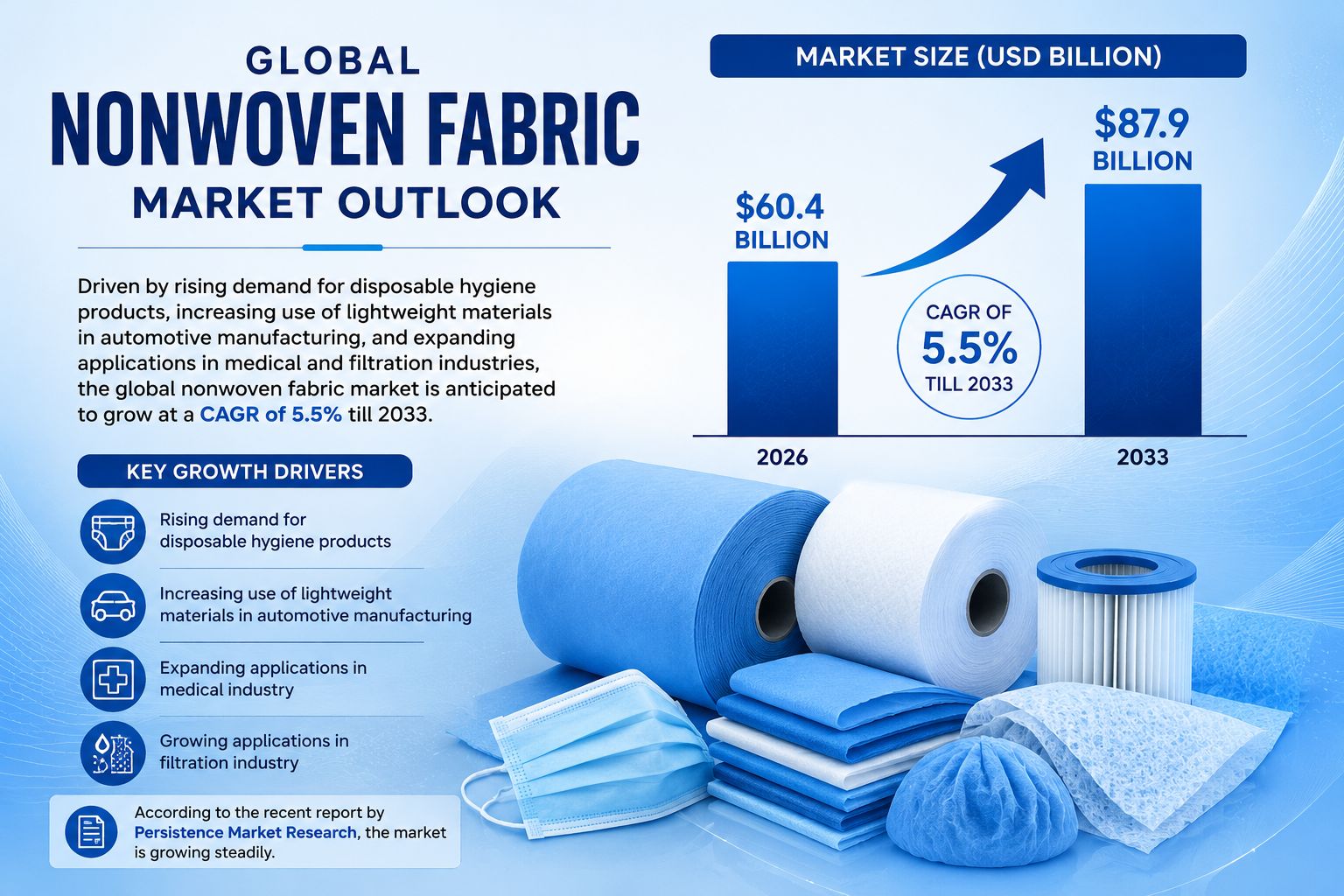
Nonwoven fabrics rarely get noticed — and that is precisely the point. They work quietly in the background, in hospitals, cars, homes, and factories, doing essential jobs that most of us never think about. The surgical mask, the baby diaper, the air filter in your car — all of them owe their effectiveness, in no small part, to nonwoven fabric technology. And, the market that supports all of this is growing steadily, expected to rise from $ 60.4 billion in 2026 to $ 87.9 billion by 2033, at a compound annual growth rate of 5.5%, according to Persistence Market Research.
What makes nonwoven fabrics so useful is a combination of properties that is hard to replicate: they are durable yet lightweight, cost-efficient yet absorbent, and capable of filtering out particles that other materials cannot. These qualities have made them indispensable across industries as different as healthcare, automotive, construction, and agriculture.
Hygiene Drives
The single biggest driver of demand for nonwoven fabrics is hygiene. Baby diapers, feminine hygiene products, adult incontinence items, surgical gowns, face masks, and medical wipes all rely on nonwoven materials for their softness, absorbency, and breathability. As populations age in developed economies across North America, Europe, and Japan, demand for adult incontinence products is rising. At the same time, higher birth rates and improving living standards across Asia Pacific and Africa are accelerating diaper adoption. The result is a sustained, broad-based expansion in demand that shows no signs of slowing.
In healthcare settings, the case for nonwoven fabrics is equally compelling. Surgical drapes, sterilization wraps, and protective apparel made from nonwoven materials reduce contamination risks and improve safety in ways that reusable fabric simply cannot match. In emerging economies, expanding healthcare infrastructure and government investment in public health are creating an entirely new wave of demand for medical-grade nonwoven products.
Cars transformed
The automotive industry has emerged as one of the most exciting new frontiers for nonwoven fabric manufacturers. As automakers push to reduce vehicle weight — to improve fuel efficiency and cut emissions — nonwoven materials have found their way into carpets, trunk liners, insulation systems, cabin air filters, and acoustic components. Their high strength-to-weight ratio and cost efficiency make them an attractive alternative to heavier conventional materials.
The shift to electric vehicles has added a new dimension to this story. EV manufacturers need specialised nonwovens for thermal insulation, battery protection, and noise and vibration control — applications that did not exist in the automotive supply chain a decade ago. In Europe, strict emissions regulations are pushing greater use of lightweight nonwoven composites across all vehicle types. In Asia, manufacturers are scaling production rapidly to meet the demands of the mass-market electric mobility boom.
Technology Matters
Not all nonwoven fabrics are made the same way, and the technology used to produce them shapes what they can do. Spunbond technology currently dominates the market, accounting for nearly 42% of total share, thanks to its cost efficiency, high production speed, and versatility across hygiene, medical, and agricultural applications. But the fastest-growing segment is meltblown technology, driven by rising demand for high-performance filtration in air purification systems, medical masks, HVAC filters, and EV battery insulation. China alone added over 450,000 tonnes of combined spunbond and meltblown capacity across nearly 32 new production lines — a signal of just how aggressively the industry is investing in next-generation capabilities.
Regional Momentum
Asia Pacific holds the largest share of the global nonwoven fabric market at approximately 44%, driven by China’s dominant manufacturing capacity and expanding consumption across hygiene, construction, and industrial sectors. China produced over 8.5 million tonnes of nonwoven materials in 2024 alone. India is emerging as a key growth market, supported by rapid urbanisation, rising incomes, and government initiatives to boost domestic manufacturing. North America, meanwhile, is the fastest-growing regional market — companies there are expanding production capacity and reducing import dependence, lessons learned painfully during the supply chain disruptions of the pandemic years. Europe continues to focus on sustainable and biodegradable nonwoven materials, driven by stringent environmental regulations and strong automotive and medical industry demand.
Industry Consolidates
The nonwoven fabric industry is not just growing — it is consolidating. One of the most significant developments in 2025 was the announcement of a global joint venture between Kimberly-Clark and Brazilian pulp giant Suzano, with Suzano acquiring a 51% stake in the new entity for approximately USD 1.73 billion. The new company will operate across more than 70 countries with around 9,000 employees and 22 manufacturing facilities, marketing brands including Kleenex, Scott, Cottonelle, and WypAll. The deal reflects a broader trend of vertical integration and strategic consolidation as leading players seek to strengthen supply chains, improve operational efficiency, and scale their presence in emerging markets.
Across the industry, the strategic focus is converging on three themes: sustainability, through investment in biodegradable and recycled materials; technology, through automation and digital manufacturing; and geography, through expansion into underserved markets in Latin America, the Middle East, and Africa. The fabric that nobody talks about is, quietly and steadily, becoming one of the most strategically important materials of the decade.
NB: Illustration is representational; report courtesy: Persistence Market Research.