

By Arun Rao
Mr Kuldeep Sangani led Alliance Fibres which is one of the earliest Indian pioneers in manufacturing recycled polyester staple fibre(r-PSF)& recycled polyester filament yarns (r-PFY)is now launching textile-to-textile (T2T) recycled polyester staple fibers and filament yarns derived from both pre-consumer and post-consumer textile waste. Alliance fibres will manufacture T2T chips and downstream products such as T2T PSF and T2T PFY.

Humble Beginnings, Bold Vision
“Alliance Fibres Pvt. Ltd. was established in 2006 by three family groups under the vision of Mr Chhaganbhai Sangani in Kim near Surat, Gujarat. The idea of entering the PET recycling business was inspired by a visit to an ITMA exhibition. The company began manufacturing of r-PSF with a capacity of 20 TPD, making it India’s third and Gujarat’s first PET recycling facility,” Mr Kuldeep Sangani, Director told The Textile Magazine.
Several Major Milestones
In 2010, the company expanded by adding an additional 50 TPD r-PSF capacity. In 2011, Alliance Fibres introduced India’s first mechanical recycled polyester filament yarn technology (20 TPD), which was later doubled by 2020. In 2015, the company started the world’s first r-PET rope manufacturing facility from PET bottle waste. In 2023, it stated a 100 TPD food-grade compliant PET washing facility catering to bottle-to-bottle applications, PET sheets, and high-end industrial uses.

Scale That Speaks for Itself
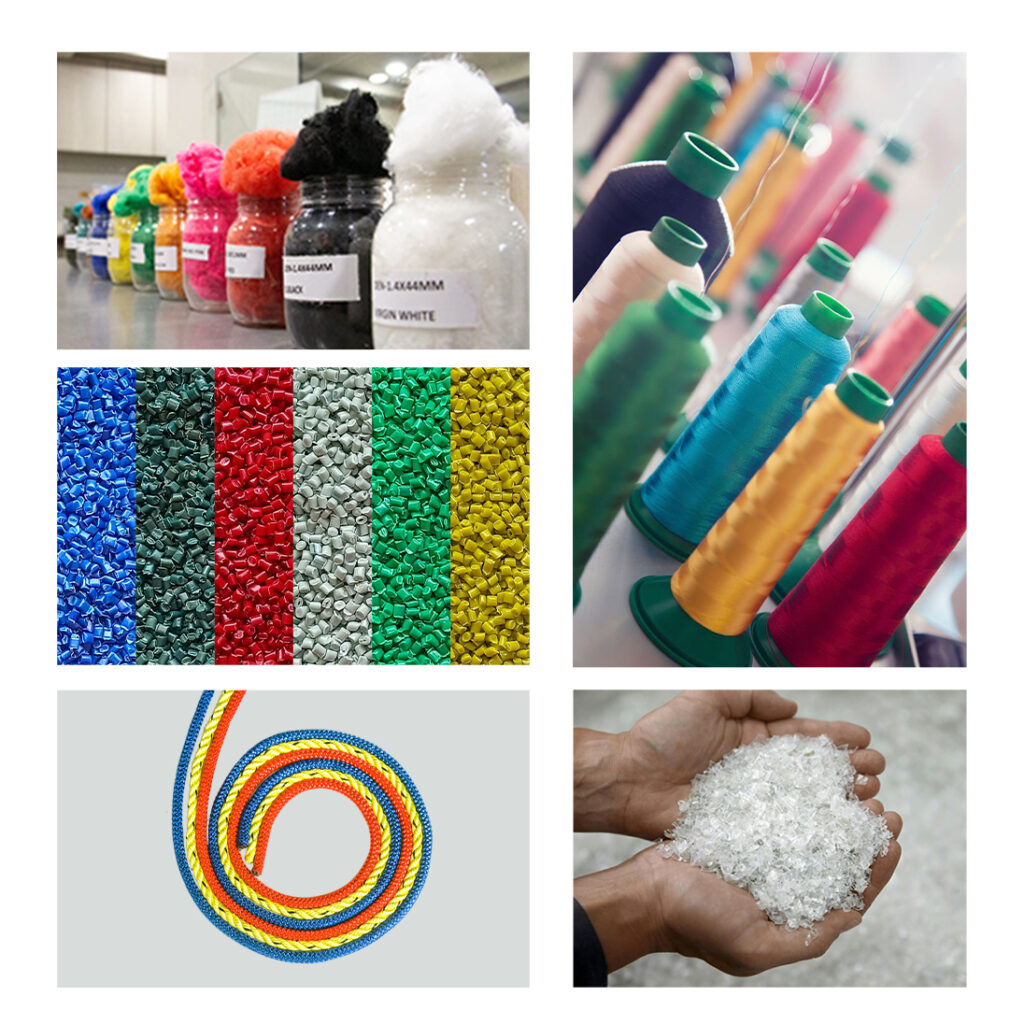
“The company operates from a single location which is spread over 35 acres and produces 24,000 MT per annum of r-PSF, 14,000 MT of r-PET filament yarns, 1,000 MT of r-PET ropes, 46,000 MT of prime-grade PET bottle flakes and 18,000 MT of r-PP and r-HDPE granules. In total, we manufacture approximately 100,000 MT of products annually, serving both the textile and plastics industries,” Mr Sangani informed.
From Geo-Textiles to Sportswear: A Versatile Portfolio
Alliance Fibres offers a wide range of technical fibres and filament yarns catering to industries and segments such as; geo-textiles, automotive, industrial filtration, insulation, medical and hygiene textiles, interiors and architecture, construction, home furnishing, fillings, spun yarns, interlinings, acoustic panels, waddings, sportswear, technical wear, and applications requiring flame retardancy (FR) and UV resistance. In addition, the company also supplies raw white (RW) and dope-dyed specialty fibres for such applications.
Trusted by Global Brands
Mr Sangani further said, “We have also been nominated by various European and American brands such as IKEA, Target, Inditex, H&M, C&A, etc. Our products are also indirectly sold to several apparel and home-furnishing brands from Asia, EU and USA.”
Innovation Driven from Within
The company has a dedicated in-house R&D facility, which focuses on developing new fibres and filament yarns through pilot spinning, enabling innovation in texture, structure, colour combinations along with the dosage of technical additives. “Our R&D team has played a crucial role in driving growth by successfully launching new product lines for entering into the new markets. We also customise and develop products based on a brand’s requirement,” he noted.
“We offer sustainable recycled products that replicate the natural look, feel, and touch of conventional fibres. This has enabled the substitution of natural fibres in several applications.These efforts benefit brands and consumers by providing cost-effective, durable, and sustainable alternatives with comparable performance to natural fibres,” Mr Sangani observed.
Green at the Core
In sustainability initiatives, approximately 70% of its energy requirements are met through solar and wind power and has recently installed 15 MW of ground-mounted solar capacity. The company has reduced fossil fuel (coal/lignite) usage by up to 80%, replacing it with bio-briquettes and pellets.
Balancing Domestic and Global Ambitions
The company’s sales are evenly split between domestic and export markets, providing strategic stability against market volatility and exports to over 26 countries and serves more than 20 industrial segments globally.
Reading the Market: Recycled vs Virgin
“The r-PSF market has witnessed significant growth in the last few years and continues to expand intonew applications. Currently, r-PSF has captured approximately 50% of the market share when comparing with virgin PSF,” Mr Sangani stated.
When considering all factors, Mr Sangani expects the market to stabilize at an approximate ratio of 60% r-PSFas against 40% virgin fibre consumption in the coming years.
“However, recycled fibres are unlikely to completely replace virgin fibres due to specific application requirements and the overall growth of polyester consumption. Currently, the diversion of PET bottle feedstock towards bottle-to-bottle applications, due to higher pricing has impacted the growth of recycled PSF,” he added.